
Rockbuttum Rhetoric
Another one shtick phoney


I know Rockhill wrote his own wikipedia page because he has a tell. All his texts repeat this risible and boring manoeuvre over and over (one of his mentor Shitzek’s favorites, but Rockhill uses it incessantly):
Rockhill has advanced a new model for thinking the historical relationship between art and politics. Rather than understanding them as two spheres separated by an insurmountable divide or linked by a privileged bridge, he demonstrates through historical and materialist analysis that they are not fixed entities with a singular relation, but rather social practices and "concepts in struggle.”
Absurdly grandiose claim. Stupid foil. Gibberish restatement of claim. (There is often a longer sequence that modifies the grandiosity and produces an oscillating alibi, but I just want to look at this little mechanism right now).
Here are some instances:
This paradox of the real phantasmatic persistence of Marxism is not just a simple conceptual contradiction. It is also not an aporia to be soberly celebrated as the profound but inevitable framework fracturing our contemporaneity. On the contrary, it is part of a historical imaginary that functions as a powerful social system of understanding that situates us in time and in a space of possibility. It thus has formidable concrete effects, for it imposes with the force of law a certain vision of the world[.]
From the same book, again (he uses the same text assembly methods as Shitzek, so is often repeating key fragments verbatim):
This paradox is not, however, a simple logical contradiction to be pointed out or celebrated as the aporia fragmenting our contemporary situation. It has formidable concrete effects insofar as it encourages the passivity of citizens before the inescapable forces of the presumed natural course of history while casting a shadow over those responsible for our supposed common destiny, thereby carefully preserving the status quo.
Another: (I really do beg your pardon, but you must endure this unbelievably self indulgent vacuous pretentious windbaggery to see the same little mechanism inside it).
Toward a New Conception of Technologies
The act of calling into question the conceptual coordinates of a significant portion of the debate on contemporary technology by no means condemns us to abandon the question of technology and of the specificity of our historical conjuncture. On the contrary, it works to create a break, profoundly and definitively, with the structures that are largely determinative of the current controversy in order to propose a different conception of technologies. Instead of searching for the umpteenth epochal concept or entering into an ultimately tiresome debate on the continuity or discontinuity of a particular social phenomenon, it is a matter of proposing an alternative historical logic in order to think the present differently, in particular by taking into account the three dimensions of history—the vertical dimension of time, the horizontal dimension of space, and the stratigraphic dimension of the diverse practices of each space-time— so as to be able to chart the metastatic transformations of our conjuncture. At the same time, it is absolutely necessary to recognize that technology is not an isolated or isolatable fact and that it is thus neither autonomous nor heteronomous. It is always interlaced with diverse sociohistorical practices. This is to say that there is no technology in the singular. There are only embedded technologies, linked in different ways to an entire field of sociohistorical, political, economic, and cultural forces. It would perhaps be legitimate to speak, in this respect, of a technological ecology in as much as technologies constitute themselves by composing a world with an entire ensemble of practices.
There is a variation, more often deployed in lectures than in text, also learned from Shitzek, which is the typical disavowal and reinscription, or what we can call ‘I’m not a racist but…(the white race does exist and is superior, let’s be frank!)’
As soon as you mention the Central Intelligence Agency, this captures a lot of headlines and people think in conspiratorial terms because they're programmed by liberal ideology to think that there's a puppet master and a bunch of strings and then a bunch of puppets who are being run by them. And there's not an analysis of the material system of ideological production, dissemination, and reception. And this is really what my book offers is an analysis of what I refer to as the imperial superstructure which includes the cultural apparatus of cultural production and dissemination, but also the political and legal apparatus that has within it certain the cultural and intellectual sphere from behind the scenes in various ways. So you can't just pick out the CIA and make it a story about the Central Intelligence Agency. What you need to do from a dialectical and historical materialist vantage point is situate that agency is a product of imperial social relations. Right? The reason that we have the CIA is because it is the running dog of the capitalist ruling class and it needs to be situated within this broader imperial superstructure as a important agency within the political legal apparatus that works handin glove with various forces in order to control and try to uh direct the overall cultural apparatus within which the intellectual apparatus is a significant part.
Statement, disavowal, restatement, with the foil embedded.
Needless to say his book contains no account of the production and reproduction of the CIA or its associated foundations, or anything resembling a dialectical materialist analysis of any sort. In one laughable chapter he proposes this ‘dialectical materialist analysis’ consists of a list of the salaries of academic celebs in contrast to the underlings, and even provides these data in a preposterous infantile way that vastly reduces the differences (no discussion even of tenure and pensions, that is, deferred comp, only, as typical, — ‘one day we need to talk about class war!’ - an admission of choosing not to discuss them), no discussion of universities as institutions, soft funding, endowments, and even more shockingly no mediology. Absolutely none. It’s simply childish gossip, hedged with a list of things he won’t write about as if that list of unperformed scholarly work acquitted his obligations as a scholar and his promises that we will find precisely this work inside these covers.
But that’s for another post. Here I want to just look at this tiresome rhetorical two-step from the Shitzek handbook at work, and in the next post probably (cuz this is boring me to death, and so I sympathize with you) show that it is also the structure of the whole scam.
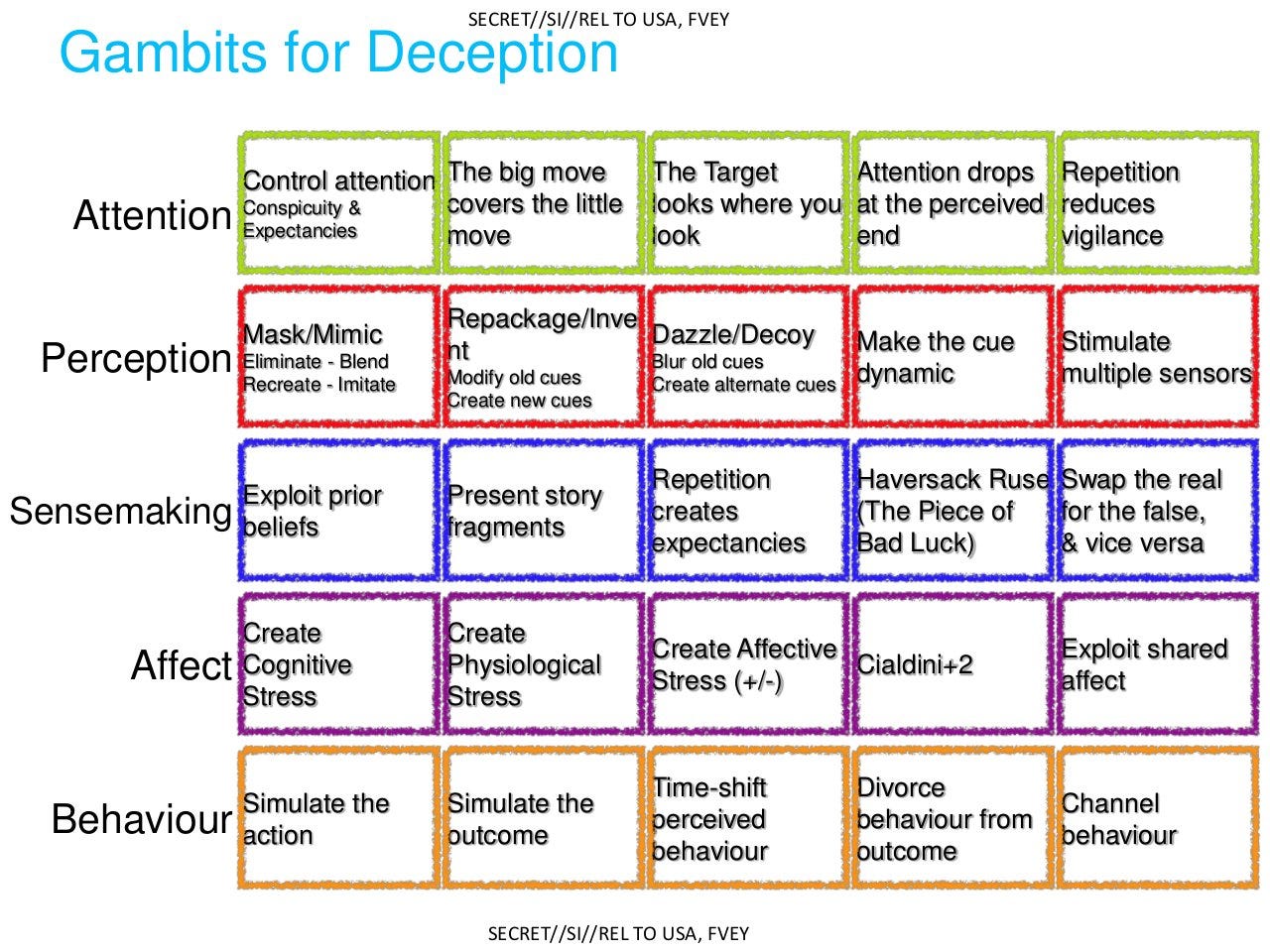
I need to draw your attention for a moment to the fact that Rockhill likes to oscillate as Shitzek does between insisting he is an elite, elitist, educated, cultured, aesthetically refined Marxist philosopher who sees through everyone and everything, and ‘confessing’ he is a bumpkin candide whose good faith is repeatedly abused and who has to be forgiven his reactionary impulses and outbursts because he is from MAGAland which is much like Slovitzia. So normally if asked about his paratexts, he would suck his thumb and look innocent. But in the talk with Marxist library, the dustin-hoffman-in-wag-the-dog side of the Shitzekian could not be contained when he wanted to show that he was aware of the Shitzek CIA propaganda repertoire, so he very breathlessly and eagerly, like the brown noser he must have been all his life, boasted to his hosts that he had noticed that the Shitzek Birkbeck outfit, that’s getting money from Soros (and Rockhill weirdly insists Soros was first there, and then they hired Shitzek, in his ongoing insistence that Shitzek is just a weird independent- thinking clownish entertainer that the ruling class likes, but it was Shitzek that got the money) put a quote attributed (likely wrongly, which he didn’t see fit to mention) to Rosa Luxemburg on their website:
And very tellingly they have a citation a quote - and I’ll conclude with this - from Rosa Luxemburg which is freedom is the freedom to think otherwise. This is unattributed but anyone who knows Luxembourg will immediately recognize that it's her critique of the Russian revolution that she published in 1918 claiming that it was non-democratic dictatorial etc. So they were directly hood you know eyewinking if you will to the anti-communist leftist intelligensia saying come and study with us we will give you the form of education that is the vanguard of quote unquote Marxist scholarship in the imperial core.
The epigraphs of Rockhill’s book are also of course winking (and hoodwinking, as he decided not to say).
Here’s the one I mentioned in the last post:
To ascribe to an opponent an obviously stupid idea and then to refute it is a trick practiced by none too clever people. —V. I. LENIN

It’s almost like quoting Lenin saying ‘cats are so cute.’ It’s something Lenin said in an ordinary way, a commonplace, a bit of wisdom he uttered to remind his readers of it for a purpose in the midst of an important argument. Since we know, however, as we see amply demonstrated above (and you’ll be amazed if you go through his books how often he presents these straw men and foils), that this crude tactic is a central pillar of Rockhill’s texts, bearing the weight of all his cacamamie statements and boasts, we may very rightly wonder what this quote from Lenin is doing (literally as well as sarcastically wonder) at the head of this chapter.
The chapter is State Department Anticommunism Outsourced to the Academy.
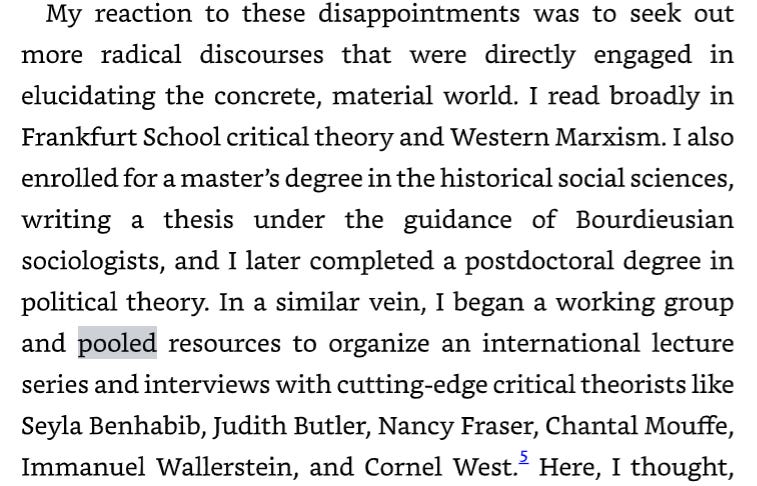
Not irrelevantly to my point, but another thing I’m going to postone discussing, this chapter is lifted whole from Tim B. Mueller’s book, as the footnotes reveal. And even the footnotes which do not trace to Mueller’s book are lifted from Mueller’s book, being his citations (including the citation to Marcuse’s own work.)
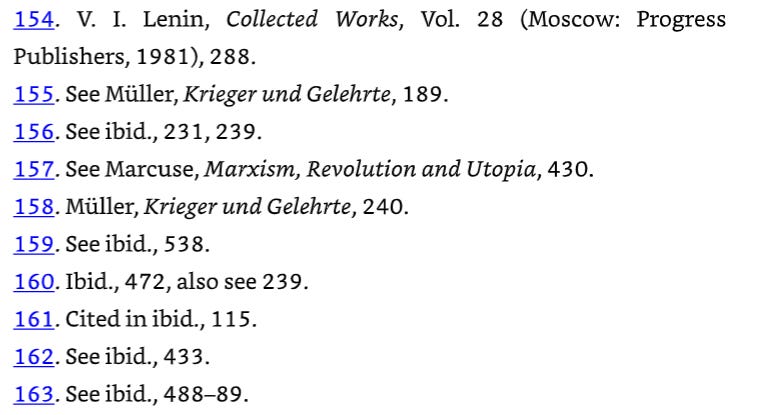
By the way I learned yesterday that Gabriel Rockhill lately runs his Critical Theory Workshop, described in the book as the product of ‘pool[ing resources]’ in activist circles, with a grant from the Herbert Marcuse Society.

Ok end divagations.
The sort of severed finger quotation from Lenin, that becomes nothing but a platitude once hacked off its context — nothing but the relic of LENIN, AUTHORITY which Rockhill sports around his neck here — was advanced in the course of a famous pamphlet against Kautsky, and the content of the false accusation Kautsky is rebuked for by Lenin is not unrelated to the real work of Marcuse which actually places him on the side of present Dengism, none of which Rockhill chooses, or seemingly dares, to touch.
But Rockhill — ‘winking’ and ‘hookwinking’ as he almost said in his excitement in the video quotes above — places it at the entrance sign to this classic Shitzekian move, which is also familiar from Losurdo, to affirm the defamation of the Soviet Union by Marcuse while transforming it into the precedent and thus excuse for the counterrevolution in China:
Soviet Marxism stood Marxism proper on its head by transforming a philosophy of liberation into a philosophy of subjugation, engendering a society far worse than capitalist societies. “Compared with the Marxian idea of socialism,” Marcuse wrote in his 1954 epilogue to Reason and Revolution, “Stalinist society was not less repressive than capitalist society—but much poorer.”172 Devoid of any clear grasp of imperialism, the dialectics of socialism, or a fine-grained materialist account of the arduous difficulties faced by the world’s first socialist state, Marcuse engaged in a puerile celebration of a utopian version of socialism in order to juxtapose it to the horrors of socialism in the real world. He clearly had not learned a lesson that Paul A. Baran, who had also served in the OSS, had tried to teach him in their personal correspondence as early as 1954:
But if it is possible—and historically it has proven to be possible—for a socialist party to seize power a long way before the conditions for a socialist society have materialized, all that can be reasonably demanded is that this party should do the best it can in promoting the cause of socialism at home and abroad. NB: the best it can is not the best one could think of—there is no more room for utopianism here than before. If this test is applied, I would submit that the Russians have done extremely well, so well in fact as to surpass the most optimistic expectations.173
Gotta run so stopping here. Back soon